
Child Safety in Early Childhood Education:
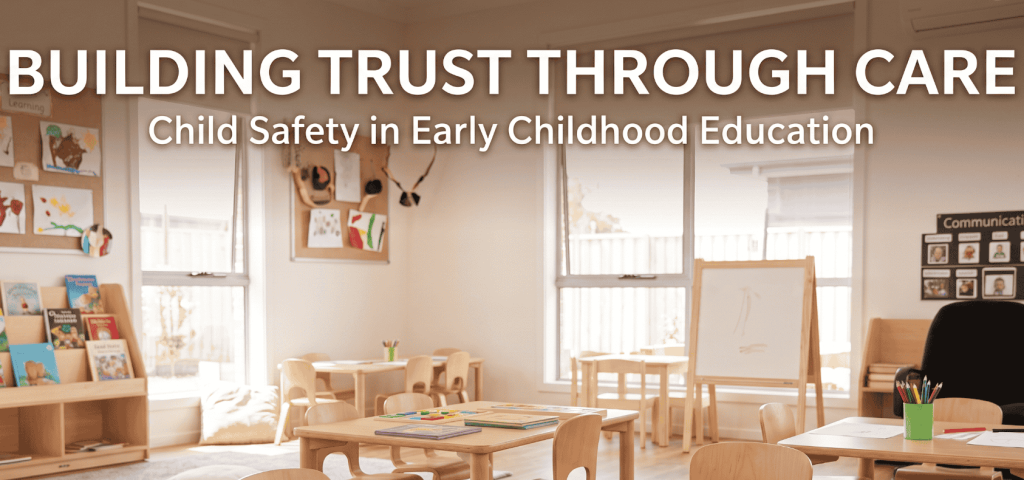
Child Safety in Early Childhood Education: Building Trust Through Culture, Accountability and Care In recent years, the safety and wellbeing of children in early childhood education and care (ECEC) settings has rightly become a focus of national conversation. Following the deeply concerning child safety incidents that came to light across the sector last year, families, providers, regulators and educators have all been reflecting on what more can be done to ensure children are protected in every setting, every day. While these events have been distressing for families and professionals alike, they have also reinforced an important truth: child safety must remain at the centre of everything we do. At Eltham Foundation, child safety has never been viewed as a box to tick or a policy to file away. It is a core responsibility that underpins our culture, our practices and our decision-making across all five of our early learning services. As a not-for-profit organisation, our focus has always been on providing high-quality education and care for children. Every dollar we generate is reinvested back into our centres, our learning environments and our people. This allows us to continually strengthen the systems, training and professional development that help create safe, nurturing environments where children can thrive. Child Safety Is More Than Compliance The recent introduction of strengthened child safety measures across the early childhood sector has been welcomed by providers committed to continuous improvement. These reforms reflect growing recognition that safeguarding children requires robust systems, strong leadership and a culture of accountability. However, legislation alone cannot keep children safe. Research arising from the Royal Commission into Institutional Responses to Child Sexual Abuse highlighted that organisations best equipped to protect children are those that foster child-safe cultures—where safeguarding is embedded into everyday practice, concerns are taken seriously, and all adults understand their responsibilities. For children to be genuinely safe, child protection must be woven into every aspect of an organisation, from recruitment and induction processes through to professional learning, supervision, leadership and governance. At Eltham Foundation, many of the practices now being strengthened through legislative reform have long been part of our commitment to quality care. We have consistently invested in professional learning, robust governance and reflective practice because we believe children deserve environments that prioritise both their safety and their wellbeing. Why Professional Learning Matters One of the most effective ways to strengthen child safety is by investing in the people who care for and educate children every day. Early childhood educators hold a unique position of trust. They are responsible not only for supporting children’s learning and development, but also for recognising signs of vulnerability, responding appropriately to concerns and creating environments where children feel secure and respected. This is why a significant portion of Eltham Foundation’s budget is dedicated to staff training and professional development. Ongoing learning helps educators stay current with best practice, strengthens their understanding of child protection responsibilities and supports a culture of continuous improvement. It also provides opportunities for teams to engage in reflective discussions about safeguarding, professional boundaries, supervision practices and children’s rights. Research consistently demonstrates that workforce quality is one of the strongest predictors of quality outcomes in early childhood education. Highly skilled, well-supported educators are better equipped to create environments that are both enriching and safe. For us, investing in our team is ultimately an investment in children. Safety Through Visibility and Accountability High-quality early childhood education does not happen in isolation. One of the strengths of a centre-based environment is the collaborative nature of the work. Educators operate as part of a professional team, working alongside colleagues, educational leaders and management who support, guide and observe practice throughout the day. This creates multiple layers of visibility and accountability. Children are known by many trusted adults. Educators engage in ongoing communication and collaboration. Practices are regularly reviewed, discussed and refined. Questions can be asked, concerns can be raised and support can be provided when needed. Strong safeguarding frameworks recognise that transparency and accountability are critical components of child safety. When professional practice occurs within a culture of shared responsibility and oversight, organisations are better positioned to identify risks, uphold standards and continuously improve. Importantly, this team-based approach also supports children to build secure relationships with a range of trusted educators, helping them feel confident, connected and supported throughout their early learning journey. Creating Child-Safe Cultures A child-safe organisation is one where children’s rights, voices and wellbeing are actively prioritised. The National Principles for Child Safe Organisations, developed following recommendations from the Royal Commission, emphasise the importance of listening to children, empowering families, maintaining strong governance and fostering environments where concerns can be raised without fear. Creating a child-safe culture means asking ourselves important questions every day: Are children being heard? Do families feel informed and included? Are educators confident in their responsibilities? Are our systems effective and transparent? Are we continually looking for ways to improve? At Eltham Foundation, these questions guide our ongoing commitment to quality and safety. Child safety is not achieved through a single policy or training session. It is built through thousands of daily actions, conversations and decisions that place children’s wellbeing at the centre. Partnering With Families Families place enormous trust in early childhood providers. Entrusting someone else with your child’s care is one of the most significant decisions a parent can make. That trust should never be taken for granted. We believe strong partnerships between families and educators are an essential part of creating safe environments for children. Open communication, transparency and shared understanding help build confidence and ensure that concerns can be addressed quickly and effectively. Parents and carers should feel comfortable asking questions about child safety practices, supervision arrangements, educator qualifications and organisational policies. Quality providers welcome these conversations because they reflect a shared commitment to children’s wellbeing. When families and educators work together, children benefit. Looking Forward The events that prompted renewed scrutiny of child safety across the sector were confronting and deeply upsetting. They reminded all of us that safeguarding children
7 Key Benefits of Early Learning
How It Shapes a Child’s Future Success First Day at Early Learning Centre It’s a bright Monday morning in Melbourne. You’re standing outside the early learning centre with your young child holding onto your leg, their oversized backpack nearly toppling them over. Around you, other parents and carers are doing the same nervous shuffle — half-smile, half-heartache. Educators are inside, ready with puzzles, paint pots, and a cheery “good morning.” Let’s be honest — that first drop-off tugs at your heart. You’re proud and excited, but also quietly asking yourself: Is this really going to set them up for life? The answer is yes. Neuroscience shows that about 90% of a child’s brain develops before age five. The Australian Early Development Census (AEDC) indicates that children who attend preschool are up to 50% less likely to start school developmentally vulnerable. In short, early experiences shape not just early learning confidence but also lifelong success. So, here are the early learning benefits Aussie families care about — and how to spot them when you walk through the door of a high quality early educations centre. What is early learning? A play-based, educator-guided program for children 0–6 that builds cognitive, social, emotional, language, and physical development, aligned to Australia’s Early Years Learning Framework (EYLF) and assessed under the National Quality Standard (NQS). 1. Cognitive Growth: Little Brains, Big Thinking How play builds problem-solving Children learn through play. Learning, for all of us, occurs best when we are interested, engaged and feel safe. Children thrive when their environment is stimulating and engaging, an environment that allows for exploration and inquiry. Problem solving is encouraged and fostered when children build a block tower then tip it over, pour sand from one tub to another, drop food from their high-chair (sigh!), and ask “why?” over and over and over again! These are all examples of cause-and-effects in play. It fosters persistence, curiosity, and logical reasoning, exploring and repetition in play build the brain connections and . These skills are the foundation for future science and math learning. Early literacy & numeracy Early literacy and numeracy start developing in our youngest children. Through songs, movement, reading, sorting, and comparing, children are beginning to wire their brains for reading and mathematics. Research shows that children who engage in these skills early become more confident and ready learners when they begin Foundation at primary school. Anecdote: Meet Jack! Jack was a shy little boy, who had a love for puzzles. When he first started kindergarten, he struggled to engage. Within just a few weeks, however, Jack had gone from tentative attempts at small puzzles to proudly completing a 12-piece jigsaw. Jack’s educators explained that by nurturing Jack’s interest in puzzles, they helped him feel confident and secure in his new environment. Once he felt comfortable, he began making friends and could focus more easily on the activities he loved. With the encouragement and support of his educators, Jack’s confidence grew quickly—and so did his puzzle skills! Tips for parents touring Centrers: Ask how their educators scaffold learning (Do they model curiosity? Do they follow children’s own inquiries?). Look for open-ended materials like blocks, repurposed materials, sensory play and items from nature. Watch if children are encouraged to solve problems themselves before an adult steps in. 2. Social Skills: Belonging and Teamwork Sharing, turn-taking, negotiating Children’s peer interactions can sometimes be challenging — deciding who gets the red truck or who takes the lead in a sandpit scenario is all part of learning to navigate social relationships. Play in the early years provides valuable opportunities for children to practice real‑world problem solving in a safe, supported environment. Friendships & inclusion practices Our educators guide children through respectful conversations and help them develop important skills such as conflict resolution, empathy, and turn‑taking. Within our group setting, we intentionally foster an atmosphere where differences are recognized, respected, and celebrated. This ensures every child feels a strong sense of belonging and learns how to build positive, inclusive relationships with others. Anecdote: Aarav joined our service in the Kinder room; he had recently moved with his family from India. He spoke very little English and was very reluctant to join into play. During our Diwali celebrations, the educators engaged Aarav’s family and invited Aarav to share his family’s culture with his peers. He was able to share his traditional dress, the things his family does to celebrate Diwali and Educators were able to play some Indian music for his peers to dance to. The educators noted that Aarav came out of his shell and demonstrated great pride in his culture and the opportunity to share it with his new peers. After Diwali, Aarav seems to feel more confident and comfortable in his environment and has formed some beautiful friendships. Tips for parents: During a tour, watch how educators foster learning during transitions (pack-away, mealtimes. Etc.) Are all children engaged in play and are educators engaging with children? Ask about inclusion strategies for children with different learning or developmental needs Ask about how children are encouraged to learn about cultures other than their own. 3. Emotional Development: Resilience for Life Emotional Regulation Strong emotions are a natural part of early childhood development—whether it’s a toy being taken, a missing shoe, or a friendship that feels uncertain. Building resilience in these early years involves helping children learn to recognise and name their emotions. For babies and toddlers, this can be as simple as saying, “I can see you’re frustrated.” Hearing this language regularly helps children begin to identify how they feel as they grow. By the time children reach 3- and 4-year-old kindergarten, they are guided to understand not only what they are feeling, but also how to express those feelings appropriately. For example: “I can see you are frustrated. It’s okay to feel frustrated, but it’s not okay to hit. What can you do to calm your body without hurting someone else?” Children are then supported with practical strategies such as breathing techniques,